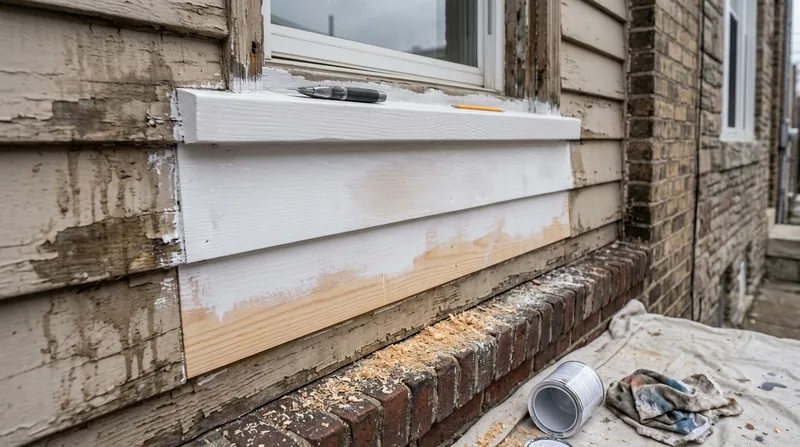




Wood rot and dry rot repair in Philadelphia is a year-round necessity in a city where century-old rowhouses, Victorian twins, and stone homes face constant moisture pressure from freeze-thaw winters and humid summers. The Delaware and Schuylkill River valleys create a changeable Mid-Atlantic climate that drives water into wood framing, sills, trim, and exterior sheathing faster than most homeowners realize. We cut out decayed wood, treat surrounding framing to stop further spread, and rebuild with rot-resistant lumber for a permanent repair, not a cosmetic patch. Whether the damage is in a sill plate under a Fishtown rowhouse, a rim joist in a Germantown Victorian, or fascia and soffit on a Main Line colonial, the work is the same: remove the rot, stabilize the structure, and restore the wood right.
Why Wood Rot & Dry Rot Repair Matters in Philadelphia's Historic Housing Stock
Philadelphia's residential neighborhoods are defined by their age and material authenticity. Most of the rowhouses in South Philly, Kensington, and the Northeast were built between 1900 and 1950 with wood framing, wood sills, and wood trim that has now endured more than a century of seasonal moisture cycling. The region's humidity in summer and freeze-thaw cycles in winter create ideal conditions for wood decay. Untreated rot doesn't stop on its own; it spreads through joists, sills, and structural members, weakening the framing that holds your floors level and your walls plumb. Early repair saves money and prevents more costly structural work down the road.
- Sill plate rot undermines the bearing surface where walls sit on the rim joist, causing floors to settle and doors to bind.
- Floor joist decay reduces the load capacity of your subfloor and can lead to soft spots, bounce, or sagging.
- Rim joist and band board rot weakens the box that ties your floor framing to your walls and allows water to enter the rim space.
- Fascia and soffit rot exposes rafter ends and allows water into the attic, where it migrates down into walls and framing.
- Exterior trim and siding rot creates entry points for water into the wall cavity and behind interior plaster.
Catching rot early and cutting it out cleanly is far more cost-effective than replacing entire floor systems or framing bays later. For detailed guidance on permits and structural work in Philadelphia, consult the City of Philadelphia L&I Permits Office, which oversees building code compliance and structural alterations in the city.
Key info: In Philadelphia rowhouses, sill plate rot is the most common structural wood decay we encounter. The sill sits directly on the top of the brick foundation and absorbs moisture from rising damp, mortar joints, and splash-back from rain. We remove the rotted sill section, sister in new pressure-treated lumber, and bed the new wood in sealant to stop re-wetting.
How We Repair Wood Rot in Philadelphia Homes: Step-by-Step Process
Our approach to wood rot repair is methodical and conservative. We start by identifying the full extent of decay, then remove only the compromised wood. We treat the surrounding sound wood with a penetrating preservative to prevent new rot from starting in the exposed grain. We rebuild with lumber rated for the specific location: pressure-treated framing for below-grade or high-moisture areas, and rot-resistant species like redwood or naturally durable lumber for trim and siding. The goal is a repair that lasts as long as the original wood did, without shortcuts or cosmetic coverage.
- We probe the wood with a sharp tool to establish the boundary between sound and decayed material.
- We cut out all soft, discolored, or crumbly wood, creating clean, square edges for a tight fit with new lumber.
- We treat the exposed wood and surrounding framing with a wood preservative to arrest any incipient decay.
- We measure and cut replacement lumber to match the original species, grade, and dimension whenever possible.
- We install new wood with corrosion-resistant fasteners and seal all end grain and joints against water entry.
- We finish the repair with paint or stain to match the surrounding wood and protect the new lumber from UV and moisture.
Most rot repairs in Philadelphia homes involve either a localized cutout and replacement (a section of sill plate or rim joist), or sister joists alongside a decayed floor joist to restore load capacity without removing the original member. For more extensive structural decay, we may recommend consulting the building department about whether a structural beam replacement or joist replacement is the right path.
Example: A rowhouse in Upper Darby with a decayed rim joist under the first-floor front wall. We removed the rotted section (about 4 linear feet), sistered a new pressure-treated rim board to the existing joist, and sealed all joints. The repair took one day and cost far less than replacing the entire joist run or underpinning the wall.
Wood Rot Repair Methods: Cutout, Sister Joist, and Full Replacement
| Approach | Description | Best for |
|---|---|---|
| Localized Cutout | Remove rotted section, treat surrounding wood, install new lumber of matching species and dimension, seal all joints. | Rot confined to a single joist bay, sill section, or trim run; sound wood remains on either side. |
| Sister Joist | Install a new pressure-treated joist alongside the decayed original, bolted to it at intervals, to restore load-bearing capacity without removing the compromised member. | Floor joist rot where the original joist is still partially sound and removal would require shoring; adds cost but avoids disruption. |
| Full Joist Replacement | Remove the entire decayed joist, shore the floor above, install a new pressure-treated joist of the same dimension, bolt to rim and band board. | Rot extends along more than half the joist length or decay has compromised more than 30 percent of the member's cross-section. |
| Sill Plate Repair | Lift the wall frame on temporary posts, remove rotted sill, install new pressure-treated sill, re-seat the wall, and seal the new sill bed in sealant. | Sill rot in rowhouses and older frame homes where the sill absorbs moisture from the foundation or rising damp. |
The method we choose depends on the extent of the decay, the structural role of the member, and whether the surrounding wood is sound. We always recommend repair over replacement when the original wood is salvageable, because it preserves the integrity of the framing and avoids the cost and disruption of full-member removal.
Wood Rot & Dry Rot Repair Cost in Philadelphia: What to Expect
Wood rot repair costs in Philadelphia typically start at $650 for a small localized cutout and scale upward based on the extent of decay, the member being repaired, and access. A sill plate repair in a rowhouse might run $1,200 to $2,400 depending on the length of rotted sill and whether the wall requires temporary shoring. A floor joist replacement with shoring and new pressure-treated lumber can range from $1,800 to $3,500 per joist. Sister joist work to reinforce a decayed joist without removal typically costs $1,400 to $2,600. Fascia and soffit repairs start lower, around $800 to $1,500, because they don't require structural shoring.
The main factors that move your cost up or down are:
- The linear footage of decayed wood that must be removed and replaced.
- Whether the repair requires temporary shoring to support the floor or walls above.
- Access to the rotted member (basement work is faster than working from inside a finished room or from scaffolding outside).
- The species and grade of lumber required (pressure-treated framing is standard; rot-resistant species like redwood cost more but last longer).
- Whether finishing and painting are included or handled separately.
We always provide a detailed written estimate after an on-site inspection. We recommend getting 2 to 3 estimates from local carpenters so you can compare scope, materials, and price. See our full pricing overview for additional context on how we structure estimates and what's included at each price point.
Wood Rot & Dry Rot Repair Near Me: What Philadelphia Homeowners Should Know When Hiring a Carpenter
Finding the right carpenter for wood rot repair means looking beyond price. You want someone who can diagnose the decay accurately, explain why repair makes sense over replacement, and use the right materials for the job. In Philadelphia, we operate as a registered Pennsylvania Home Improvement Contractor and comply with City of Philadelphia L&I requirements for any structural or load-bearing work. We are fully insured, and we carry documentation of our coverage available on request. When you call for an estimate, ask the carpenter to explain the extent of the rot, what wood will be removed, what will replace it, and why that approach makes sense for your home.
Here are the key things to verify when hiring:
- Confirm the contractor is registered with the Pennsylvania Home Improvement Contractor Board and verify their standing with the City of Philadelphia L&I office.
- Ask whether any part of the work will require a permit from the building department (structural repairs, wall alterations, and floor joist replacements often do).
- Request references from recent wood rot repairs in Philadelphia or nearby towns like Cherry Hill, Bensalem, or Upper Darby.
- Get a written estimate that specifies the lumber type, the extent of cutout or replacement, and whether shoring or temporary support is included.
- Check whether your homeowner's insurance policy covers wood rot repair and ask the contractor whether they can help document the damage for a claim.
- If your home is in a historic district or HOA community, verify that the repair materials and methods comply with any architectural review requirements.
Wood rot repair is not a cosmetic job, and it's not one to rush. The same carpenter should do the work from start to finish, and they should explain what they find and why the repair method makes sense. If you're ready to get started, contact us for a free estimate. We respond within 24 hours and can usually schedule an inspection within a few days.
Wood Rot & Dry Rot Repair in Philadelphia: Pricing Guide
| Service | Price | Details |
|---|---|---|
| Small localized cutout and repair | Starting at $650 | Includes removal of rotted wood section, treatment of surrounding framing, and installation of replacement lumber up to 4 linear feet |
| Sill plate or rim joist repair | Starting at $1,200 | Includes temporary support or shoring if required, removal and replacement of rotted sill or rim section, sealing and finishing |
| Floor joist replacement or sister joist installation | Starting at $1,800 | Includes temporary shoring, removal of decayed joist or installation of sister joist, new pressure-treated lumber, bolting, and finishing |
| Fascia, soffit, and exterior trim repair | Starting at $800 | Includes removal of rotted trim, installation of rot-resistant replacement lumber, and finishing to match existing exterior |
| Large or complex structural repair | On estimate | Extensive rot, multiple members, or repairs requiring engineered solutions need on-site inspection to determine scope and cost |
| Free estimate and inspection | No charge | Response within 24 hours at (267) 477-7458, includes site visit and written estimate with no obligation to book |
Indicative pricing, the exact cost depends on square footage, finish, and site access. Free personalized estimate within 24h at (267) 477-7458.


